DTI vs LTV: How Income, Debt and Down Payment Shape a US Mortgage


LTV and DTI answer different mortgage questions. Loan-to-value compares the loan with the home’s appraised value. Debt-to-income compares required monthly debt payments with gross monthly income. A borrower can have a comfortable LTV and still face a high DTI, or the reverse.
This guide uses a $400,000 appraised home, an $8,000 gross monthly income and a 30-year fixed-payment illustration at 6.5% only to show the mechanics. It is not a current rate quote or an approval threshold. US lenders apply program, credit, documentation, reserve and property rules that vary by loan.
The two ratios are separate gates

LTV equals the mortgage amount divided by the appraised value, expressed as a percentage. DTI equals required monthly debt payments divided by gross monthly income. CFPB explains both ratios this way; neither number alone guarantees approval.
DTI should include the monthly mortgage obligation and other required debts the lender counts. For planning, separate principal and interest from property taxes, homeowners insurance, homeowners association dues and any mortgage insurance so no recurring cost disappears from the calculation.
Worked LTV example: $60,000 down on a $400,000 home

The arithmetic is $340,000 ÷ $400,000 = 85%. Keep the appraisal separate from the purchase price: if the appraisal comes in lower than expected, the same requested loan creates a higher LTV and may require more cash or a smaller loan.
Cash to close is not just the down payment. Closing costs, prepaid taxes and insurance, escrow funding and reserves may sit outside this simple LTV equation. Compare those items on actual Loan Estimates rather than treating a headline down-payment percentage as the full cash requirement.
Why five percentage points can change more than cash

CFPB notes that borrowers putting less than 20% down typically need mortgage insurance, although program rules differ. Private mortgage insurance protects the lender, not the borrower, and it adds to the monthly cost. That monthly cost can also raise DTI.
Do not drain emergency savings merely to hit 20%. Compare at least two scenarios: the lower-down-payment option with its mortgage-insurance cost and the larger-down-payment option with the remaining cash reserve. The better plan is the one that survives repairs, moving expenses and income disruption.
Worked DTI example: count the entire required payment stack

Use required payments, not account balances, in the DTI numerator. Credit-card minimums, auto loans, student loans, alimony or other obligations may be counted under lender and program rules. Ask the lender for the exact monthly liabilities used in underwriting when your estimate and theirs differ.
There is no single universal DTI approval cutoff for every US mortgage. Program rules and lender underwriting vary, and the Consumer Financial Protection Bureau’s current Qualified Mortgage framework does not impose a universal 43% DTI ceiling on every General QM loan. Treat online thresholds as screening guides, not promises.
LTV can move DTI because the loan size changes

This is the connection many first-time buyers miss. LTV is a balance ratio, while DTI is a payment ratio, but changing the down payment changes the balance and often the monthly payment. Mortgage insurance, rate pricing, taxes and insurance can alter the exact result.
Stress-test the payment before choosing a target price
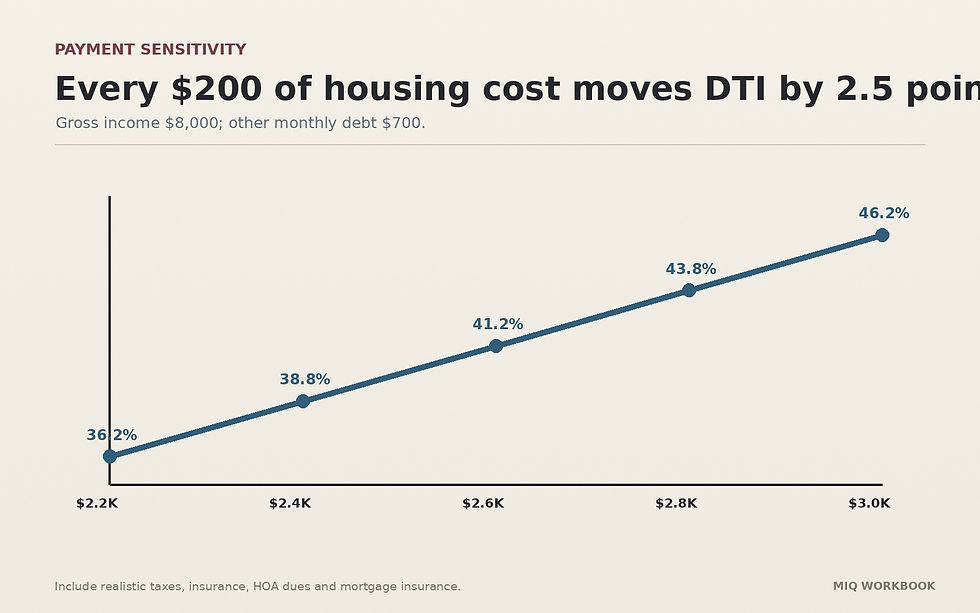
A preapproval based on an early estimate can become stale when the property, insurance quote or rate changes. Build a small range rather than one perfect number. If the comfortable budget breaks after a $200 increase, the target price may leave too little margin.

How underwriting combines the two calculations

Approval is not a contest between LTV and DTI where the lower number wins. Instead, each ratio is tested against the selected loan program and lender standards. Credit history, employment and income stability, assets, reserves, property eligibility and documentation can still change the decision.
Six numbers to collect before comparing offers

Request multiple Loan Estimates and compare the same loan type and lock assumptions. CFPB recommends using the Loan Estimate to compare offers; focus on interest rate, APR, projected payments, lender credits or points, cash to close and whether mortgage insurance can later be removed.
A disciplined sequence is: ① verify value and requested loan ② compute LTV ③ total the proposed housing payment ④ add other required debts ⑤ compute DTI ⑥ compare Loan Estimates ⑦ keep reserves after closing. Do not let a maximum approval replace your own comfortable monthly budget.
Frequently asked questions
Is 43% the universal maximum DTI?
No. Some loan programs or lenders may use that figure in particular contexts, but US mortgage underwriting does not have one universal DTI cutoff for every loan. Ask which program is being used and which monthly liabilities were counted.
Does 80% LTV guarantee no mortgage insurance?
No universal guarantee applies across every product. Conventional loans commonly use the 20%-down boundary for private mortgage insurance, but government-backed and specialty programs can have different insurance or fee structures.
Should I use purchase price or appraised value?
LTV uses the value recognized under the program’s rules, commonly the appraisal for a purchase transaction, with program-specific treatment when price and appraisal differ. Use the lender’s value in the final calculation, not an online estimate.


Comments