How to Choose Bright, Fruity Coffee Beans: Flavor Notes, Roast and Processing

Updated: 3 days ago
To find coffee with acidity you enjoy, read the flavor notes, roast description, processing method and freshness information together rather than choosing by origin alone. Variety, growing conditions, processing, roasting, water and brewing can all change what you taste in the cup.
This is a buying and tasting guide for people who like bright coffee but sometimes end up with a cup that feels harsh or hollow.
01 / Pleasant acidity is more than strong sourness
Evaluate acidity together with sweetness, aroma, balance and the finish as the cup cools. A bright sensation can be enjoyable without being the strongest sensation in the cup. Your aim is to recognize a combination you like, rather than maximize sourness.


Use the label as a starting point
Read flavour notes, roast descriptions and processing together rather than deciding from origin alone. Taste acidity alongside sweetness, aroma, balance and the finish as the cup cools. The aim is a combination you enjoy, not maximum sourness.
Keep brewing conditions reasonably consistent when comparing coffees. If a cup is sharp and hollow, change one variable before deciding that the origin is wrong for you. Record both the label information and the result in your own routine.
Citrus or floral notes may suggest a bright, fragrant impression; apple and berry may suggest a fruit-like character. Cocoa and nut descriptions point toward a different set of associations. Packaging language offers clues, but it cannot guarantee your experience or establish quality on its own.
02 / Compare roast and processing without rigid rules

Roast description is a clue
Light to medium roasts with fruit or floral notes are a practical starting point if you enjoy acidity. They are not an absolute formula. The SCA research review explains that individual acids respond differently during roasting, so perceived brightness cannot be reduced to a simple equation between roast color and acid content.

Washed and natural describe different processes
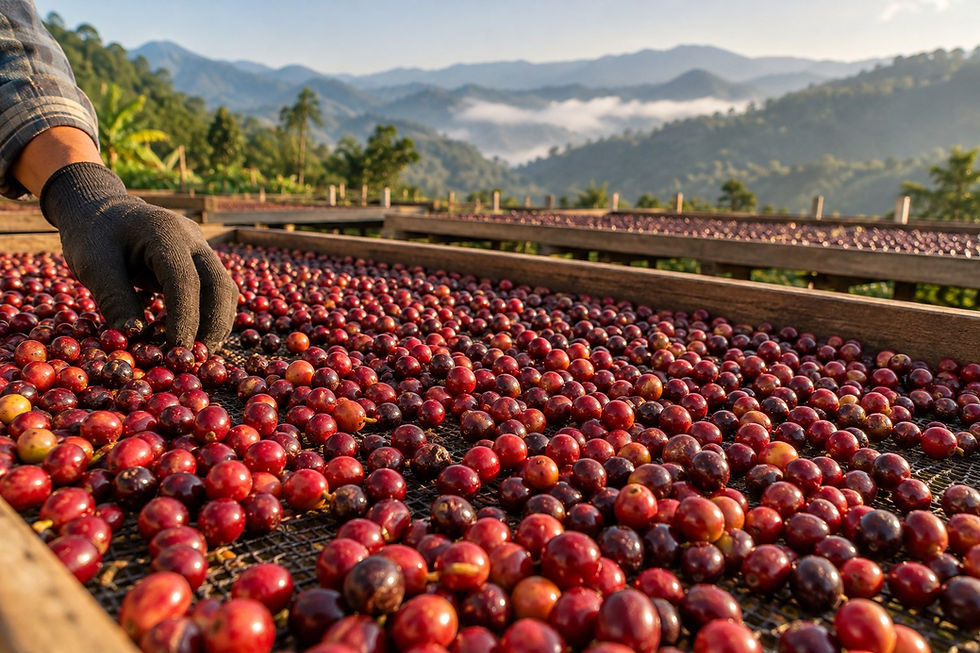
In a typical washed process, the fruit is removed before fermentation, washing and drying stages. In natural processing, the coffee cherry is dried with the fruit still around the seed. Washed coffees are often described in terms of clarity, and naturals in terms of fruit-forward character, but neither method guarantees a particular taste.

03 / Read the bag, then run a small home comparison
Read five items in order: the coffee and roaster, flavor notes, roast description, stated processing method, and roast-date or storage information. Choose fruit or floral associations that interest you. If a label omits information, ask the roaster rather than inventing an answer.

A pour-over using 15 g of coffee and 250 g of water can serve as one educational starting recipe. It is not a universal optimum; adjust for your brewer, grind, water and roast. When comparing cups, change just one variable, such as grind size or water temperature, and keep the others as consistent as possible.

Grinding very coarsely just to preserve acidity can leave a cup poorly extracted.

04 / Do not blame the bean for every sharp cup
If the first cup is sharply sour and hollow, do not immediately conclude that the bean is simply too acidic for you. Retest the same coffee with a modest adjustment, such as a slightly finer grind, while holding the rest of the recipe steady. Observe whether sweetness, body and finish become more balanced.

A tasting impression alone is not a measured extraction yield. Keep the distinction between your preference, the strength of the drink and the way it was brewed. A useful result is a comparison you can reproduce, even if you do not own measuring equipment beyond a scale.
05 / Keep a short tasting record
Record the coffee name, processing method, roast date when known, grind setting, coffee and water masses, water temperature, brew time and taste. Include sweetness, aroma clarity and aftertaste alongside acidity. Notes taken as the cup cools can reveal preferences you miss in the first hot sip.
The goal is not the most acidic bean. It is a cup with the fruit or floral character, sweetness and balance you enjoy. When comparing origins, use reasonably similar roast descriptions and brewing conditions so that the comparison remains useful.
Sources and further reading
Edited and source-checked: 17 October 2026. An independent English companion edition from MIQ WORKBOOK.

Comments